
Glendale City Directory Holdings
Arizona Memory is the clearest online starting point for Glendale city directories. Its genealogy guide reports nearly 400 Arizona directories spanning 1881 through 1989, but that broad range is not a claim that Glendale appears in every year. Confirmed local material begins in regional Salt River Valley books and later shifts toward Glendale-specific and house-to-house products. The gaps must remain visible.
| Collection | Confirmed Glendale years | Where held | Access |
|---|---|---|---|
| Arizona Directory Co., Phoenix and Salt River Valley | 1912, 1914 | Arizona Memory Project | Free OCR, page images, and downloadable material when offered |
| Later Salt River Valley volumes | 1921, 1925, 1926, 1929, 1931 | Arizona Memory Project | Glendale sections inside regional scans |
| Official Glendale-Peoria Directory including Rurals, El Mirage and Marinette | 1954 | Arizona Memory Project | Free digitized volume |
| Mullin-Kille and ConSurvey directory | 1959; 1955 conventions documented | Arizona Memory Project | Digitized scan and PDF |
| Telephone, reverse, and local-history holdings | Holdings vary | Glendale Public Library and research repositories | Catalog, noncirculating shelf, database, microfilm, or staff request |
| Public federal census schedules | 1900 through 1950 | National Archives and genealogy access points | Released under the 72-year rule |
The Arizona Memory Glendale search should be searched by surname, street, business, and volume title. Confirmed years are a minimum. A year absent from this table may still survive on a physical shelf or in a broader volume.
Glendale Inside Valley Directories
Glendale belonged to a regional publishing market. Early compilers often placed the community within Phoenix and Salt River Valley books, which means a title-only catalog search can miss it. The 1912 contents put Glendale alphabetical names at printed page 331 and classified businesses at page 345. Later regional volumes contain separate Glendale sections in at least five confirmed years from the 1920s and early 1930s.
Search OCR first, then turn to the printed contents and inspect the page image. Columns, small type, faded paper, and hyphenated surnames produce false OCR hits and missed names. Try initials, surname-first forms, spouse names, street-only terms, and forms with punctuation removed. In a city where compound surnames and diacritics are common, a single exact-match attempt is too brittle.
Note: A regional title can hold the needed Glendale city directory section even when the catalog record never uses the resident's street.
Decode Glendale City Directory Entries
A 1926 Glendale entry can combine a name, spouse, role, employer, and home address in one compressed line. “h” marks a home, while “r” identifies residence. Parentheses often hold a spouse's name. “wid” identifies a widow and may preserve the deceased spouse's initials. A business address and home address can both appear, so copying only the first number can place the person at the wrong site.
| Name | Surname, given name, and initial; OCR may split or flatten the form |
|---|---|
| Spouse or widow | A spouse may appear in parentheses; “wid” can name or initial the deceased spouse |
| Occupation | Trade, status, firm, or employer as the publisher received it |
| Business address | Workplace or firm location, separate from a private home |
| Home or residence | “h” and “r” introduce the address in inspected Glendale entries |
| Other clues | Rural route, box, phone, ownership mark, cross-reference, or advertisement |
- Criss-cross directory
- A later section arranged by street and number, useful when the address is known but the householder is not.
- Householder index
- A listing keyed to the person responsible for the published household entry, not a full resident roster.
- Abbreviation key
- The publisher's own legend for codes, symbols, occupations, and address markers. Read it before decoding entries.
The 1955 Mullin-Kille key describes house-to-house canvassing, a street and householder reverse guide, ownership marks, phones, spouses, dependents under 18, roles, and addresses. The publisher also warned of errors. Codes must be read within their own edition.
Inspect a Glendale Directory Scan
The digitized Mullin-Kille/ConSurvey volume shows why the image matters as much as the index. Page layout supplies the column order, headings, abbreviations, advertisements, and nearby entries that OCR strips away. The official Arizona Memory volume is the source for this captured example:
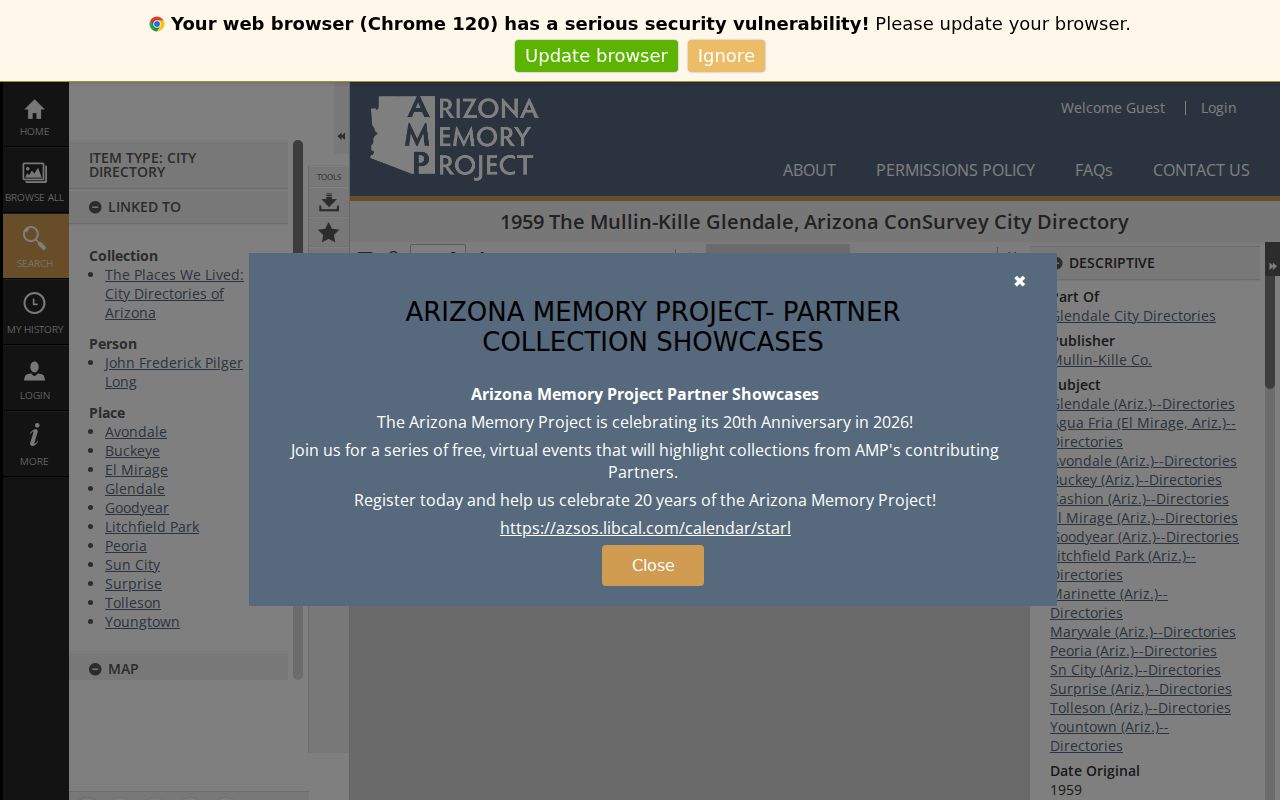
The scan gives a researcher the evidence needed to verify a hit against its printed line. Save the page number, volume title, publication year, and exact transcription so another person can reproduce the finding.
A digital search is only one access channel. If an image fails to load, use the item metadata or PDF link, ask the contributing institution, and check the library or archive for a physical or microfilm copy.
Glendale Directory Timeline
Local record keeping changed with Glendale itself. The sequence helps identify the right repository and prevents a modern city boundary from being projected onto an early address.
- 1871: Maricopa County was created from Yavapai County. Earlier land or territorial material may sit in a predecessor or federal system.
- 1890s: Glendale's townsite developed after canal and railroad work, leaving maps, plats, advertisements, and land evidence.
- 1910: Incorporation created a distinct Glendale municipal record trail preserved by the City Clerk.
- 1912 to 1931: Confirmed Glendale entries appear in Phoenix and Salt River Valley city directories.
- 1954 to 1959: Confirmed Glendale-specific and regional house-to-house directory products become available.
- Later decades: Printed and telephone sources coexist with county property systems, library databases, and digitized archives.
Early directories were chiefly name-first lists. Later reverse sections made address-first research easier. Publication and digitization did not move on one shared date, so web coverage never defines the full surviving shelf.
Trace Glendale Families by Edition
A sound family trail follows one person through available years without filling missing years by guesswork. Build a small ledger with edition, printed name, spouse, role, home address, business address, and page. Then compare each transition with a source created for a different purpose.
- Begin with the strongest known surname, approximate year, or address. Try married and birth surnames, initials, and spouse names.
- Inspect the scanned line and the edition's abbreviation key. Correct OCR errors in the research notes.
- Search the nearest earlier and later available volumes. Record changes in address, spouse notation, and role without assuming the cause.
- Use a reverse section to see the published householder at the address and to identify nearby numbered entries.
- Pair directory years with public census schedules for 1900 through 1950, then use deeds, newspapers, probate, or a vital record when legally accessible.
The 1925 publisher reported 18,960 Phoenix names and estimated population by multiplying that count for omitted women and children. That statement is direct proof that directory absence is not proof of nonresidence. It also explains why family members may emerge only in a census, school book, marriage notice, or obituary.
Map Glendale Directory Addresses
A historic address must be read in its own year. Glendale's grid, Grand Avenue, rural routes, annexations, canals, and rail alignments can make an old label hard to geocode. Compare the directory's street map with a recorded plat and legal description before deciding that a household moved. No authoritative source in the research supports one citywide Glendale renumbering year.
A criss-cross section is most useful for the publication date shown on its title page. Multi-unit, rear, rural, and vacant notations deserve a verbatim transcription. For present-day address-keyed parcels and deeds, move to the Glendale street directory instead of treating a mid-century listing as current.
Old-address tip. Resolve a vanished Glendale address with the period map and deed legal description before treating the missing label as a move.
Extend Glendale City Directory Research
Glendale Public Library is the first local fallback for physical or noncirculating directories, telephone and criss-cross books, yearbooks, newspapers, obituary files, vertical files, and current genealogy database rules. The separate Maricopa County Library District advertises library access to genealogy tools and more than 2,800 newspapers. Ask staff about the exact year and format rather than requesting “all city directories.”
The Glendale Community College archive adds yearbooks, commencement programs from 1968 through 2010, a 28-year run of The Traveler, nine years of El Tiempo Pasando, photographs, and annual reports. A yearbook can place a classmate in one academic year. A program may confirm completion, while a student paper adds club or event context. None alone proves a home address or continuous presence.
For deeper gaps, use the State of Arizona Research Library at 1901 W. Madison Street in Phoenix, 602-926-3870, the State Archives, Arizona Historical Society, Arizona Historical Digital Newspapers, and the Glendale Arizona Historical Society. The FamilySearch catalog can identify Maricopa deed, marriage, and probate holdings even when image access varies. Reading-room staff, archive finding aids, and retained originals matter when a catalog describes an item but no image appears online.
Glendale Directories Beyond the Web
“Not online” does not mean no Glendale city directory or related record survives. State Library reporting described more than 40,000 items added to the Arizona Memory Project and 9,050 genealogy books and periodicals digitized with FamilySearch. That growth expands access, but it does not replace catalog searching, repository questions, or page-level verification.
The City of Glendale collection supports searches across titles, metadata, and OCR content in municipal materials preserved since incorporation. A surname, subdivision, civic club, street, or business may appear inside minutes or a publication whose catalog title seems generic. Historical newspapers can add legal notices, advertisements, obituaries, school items, and address changes. Search the address alone when a surname fails.
Record negative results with care: name form, portal, volume, filters, page range, and search date. “No exact result in this scan” can be tested later. “No record exists” usually cannot.
Limits of Glendale City Directories
City directories were selective commercial publications. Rural delivery, new annexations, people without telephones, those who declined listing, and family members not chosen as householders could disappear from an edition. Publishers could misspell names, reuse old data, or print a business address beside a home. The 1955 publisher's own error warning should travel with any claim drawn from its pages.
A directory listing establishes an association at a stated time. Corroborate it with at least one independent source, such as a deed legal description, public census relationship, newspaper notice, yearbook, marriage file, probate record, or eligible historical vital record. Modern county records can verify ownership, but ownership and occupancy remain distinct.
Respect sealed and protected information. Do not route around confidential adoption, vital, voter, student, or court material. A careful Glendale city directory history preserves uncertainty instead of inventing a smooth household story.