
Glendale Resident Lookup Sources
No single Glendale roll confirms a full identity. Maricopa County keeps the most useful property, deed, court, and voter sources, while Arizona agencies control vital certificates, corporation filings, and many professional credentials. The City of Glendale keeps municipal court, permit, code, and administrative files. Start with the source whose purpose matches the known clue, then seek a second record with a stable fact such as an APN, case number, filing date, license number, or legal description.
| Record | What It Confirms | Official Place | Access |
|---|---|---|---|
| Assessor parcel | Owner, situs, separate mailing address, APN | Maricopa County Assessor | Free name, address, or APN search |
| Recorded documents | Grantor, grantee, document order, legal description | Maricopa County Recorder | Free index and unofficial images; official copies may cost |
| Court cases | Party role, court, case number, filing events, status | Arizona Public Access and the filing court | Free index; images or certified copies may cost |
| Voter registration | Authorized registration fields and election participation | Maricopa County Recorder/Elections | Self-lookup or restricted written request |
| Vital and probate records | Life events, relationships, estate roles, name changes | ADHS, Maricopa County, or Superior Court | Eligibility rules, forms, ID, and fees apply |
| Business and licenses | Public entity role or credential status | Arizona agencies and boards | Free public indexes; displayed addresses may be business contacts |
A resident lookup should not turn a role into a claim of residence. An assessor entry establishes an ownership link, not who occupies the parcel. A statutory agent has a corporate role. A license file confirms a credential. A court index shows that a similarly named party appears in a case, but the filing court remains the official source.
Verify a Glendale Resident
Use a two-record rule before deciding that separate hits identify the same Glendale resident. Keep punctuation, suffixes, middle initials, former names, and compound surnames. Then compare a fact less likely to be shared by a namesake. The most useful anchors are an APN, the same parcel legal description, a case number, a credential number, or dates that fit the known sequence.
- Write down the full name and every known variant. Add one anchor, such as an approximate date, past address, public role, or parcel.
- Search the Maricopa County Assessor by full owner name. Keep the physical situs address separate from the owner mailing address.
- Check the Recorder's name index for an instrument tied to that parcel. Match the APN or legal description on the image before accepting the person-property link.
- Search public court and credential indexes with the same variants. Compare court, party role, event dates, entity number, or license status instead of relying on the name alone.
- Obtain the official file or certified copy from its custodian when the result must be documented. Record the query, filters, and date so a negative finding can be repeated.
- Docket
- The ordered case record listing filings, hearings, events, and rulings. It is not the same as every underlying document.
- Index versus image
- An index points to a record and summarizes key fields. An image shows the filed or recorded document itself.
- Certified copy
- A copy authenticated by the custodian. It may carry a separate copy and certification charge.
- Situs address
- The physical location of land. It can differ from the owner's mailing address and does not prove occupancy.
When the goal shifts from one person to a full address sequence, the Glendale street directory explains the parcel and deed chain by street.
Glendale Court Lookup Checks
The free Arizona Public Access Case Lookup takes a case number or last name or business name. First name, date of birth, court, and county can narrow the query. It updates weekly and generally returns the court, case number, party role, filing date, case type or status, and docket events or disposition when supplied. A CAPTCHA comes before the search. The statewide index is not the official record. It omits sealed matters, protection orders, mental-health and probate cases, victim and witness data, juvenile matters, and some local ordinance charges. Maricopa Superior Court shows only criminal cases there. A blank result may mean an exclusion, weekly lag, spelling mismatch, or a court that supplies partial data.
| Result Field | How It Helps Confirm Identity |
|---|---|
| Court and case number | Identifies the custodian and the exact file to request |
| Party and role | Separates a plaintiff, defendant, petitioner, or other indexed role |
| Filing and event dates | Tests whether the timing fits the known person |
| Case type and status | Provides context without proving identity on its own |
| Disposition | Shows the reported outcome when the contributing court supplies it |
For Superior Court civil and criminal documents filed from July 1, 2010, Arizona eAccess uses registration and paid document access. The filing court or Clerk of the Superior Court in Maricopa County can provide the docket, page count, archive location, and plain or certified-copy options. The official eAccess page shows the document service and its coverage terms.
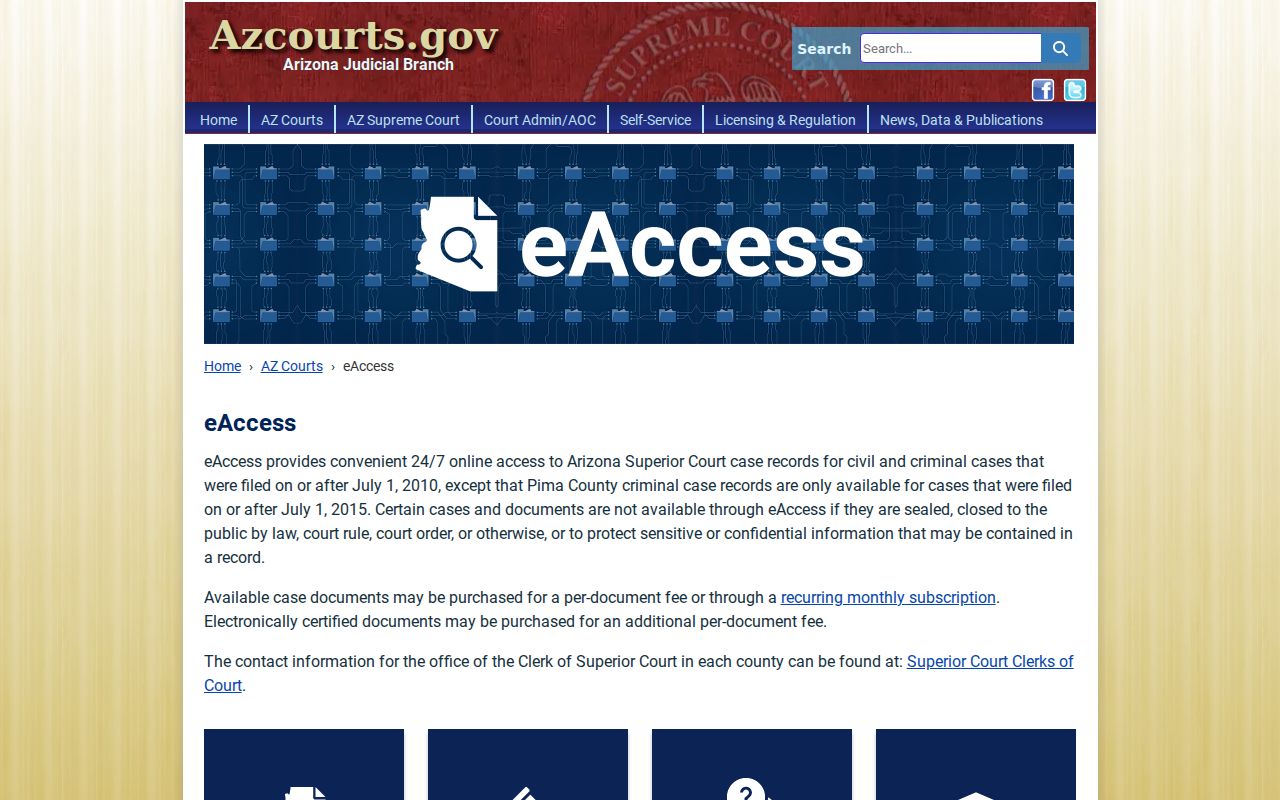
This screen is a route to eligible document images, while the clerk remains the source for official case records and certified copies. Glendale City Court can also be contacted at 5711 W. Glendale Avenue or 623-930-2400. Give the case number, parties, and year when asking for a municipal file.
Note: A matching name in a Glendale court lookup is a lead, not proof that the indexed party is the intended resident.
Glendale Vital Record Routes
Arizona does not provide one open vital-record directory. The Arizona Department of Health Services and Maricopa County issue birth and death records to qualified applicants. Marriage licenses are court records held by the Maricopa Clerk, while divorce is documented through the Superior Court docket and decree. Current birth and death certificates are confidential under Arizona law, so a resident lookup cannot bypass identity, relationship, or statutory-interest rules.
The ADHS Bureau of Vital Records supplies current forms and eligibility guidance. A certified birth or death copy is $20 in the research materials. The death application requires identifying record details, applicant contact and relationship, signature, proof, and payment. Mail requests go to P.O. Box 6018, Phoenix, Arizona 85005. Walk-in service is at 150 N. 18th Avenue, Suite 120, and the information number is 602-364-1300. A mailed request needs a signed photo ID copy or notarized signature, relationship proof, an original signature, correct payment, and a stamped return envelope.
Genealogy access follows a different clock. Arizona makes genealogical birth copies available after 75 years and death copies after 50 years, with the thresholds moving each year. Search name, year, date, and county variants through the state genealogy route, then use archives, marriage, probate, cemetery, church, newspaper, or census evidence for periods with no certificate index.
Glendale Voter Lookup Boundaries
The Arizona Voter Information Portal is a personal registration and polling lookup, not a public name directory. It requires Maricopa County, last name, date of birth, and an identification value. A resident seeking their own status can also use the county voter dashboard. Neither screen supports casual browsing of Glendale households.
Public voter data follows A.R.S. § 16-168. The Maricopa County Recorder request route accepts written requests that state the requester, scope, allowed purpose, and required certification. A file may include name, registration and residence fields, party, districts, status, and election participation, never ballot choices. The law limits use and bars unauthorized internet posting. Requests may be submitted through the portal or downloadable form, and in-person inspection is a fallback. Historical register snapshots move to the Arizona State Archives.
For one person's registration history, the county calls for full name, date of birth, and last known address. Protected voters are absent. Sealing under A.R.S. § 16-153 and the Address Confidentiality Program can lawfully make a search incomplete.
Note: A missing voter result does not show that a Glendale resident moved, never registered, or is absent from the address.
Confirm Glendale Public Roles
A company or credential record can distinguish people who share a name. The Arizona Corporation Commission's entity results may show entity type, status, formation date, statutory agent, managers or principals, an Arizona address, and filing images. Search by entity name or ID, then inspect amendments. A business address or agent address is a contact point, not proof of a Glendale home. The January 2026 move from legacy eCorp to the Arizona Business Center makes old bookmarks unreliable. The Commission paused online search and filing during the migration, while paper filing remained possible.
The successful capture from the legacy eCorp search address records what the former interface looked like:
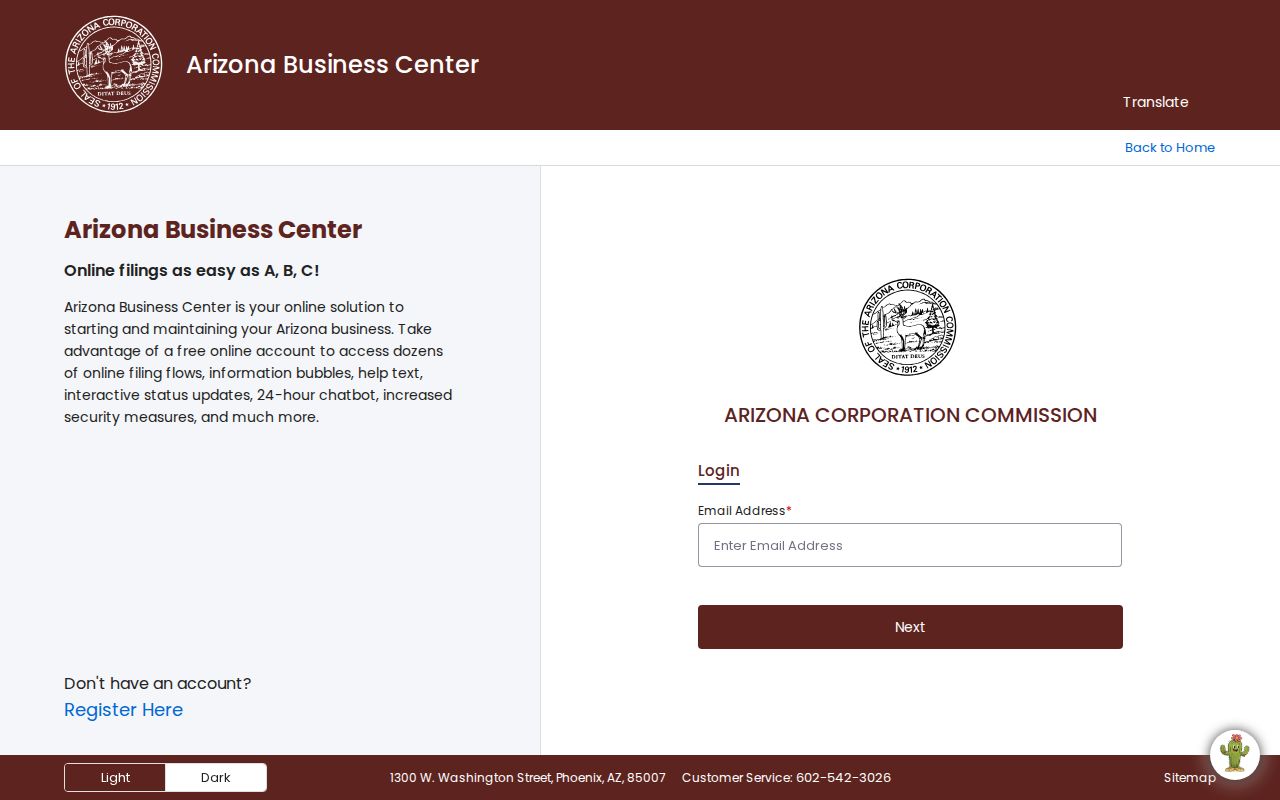
This image is historical interface evidence. Use the Arizona Business Center for a current Glendale resident lookup tied to an entity role. Professional checks belong with the issuing board. Arizona's participating-board eLicensing portal and board-specific systems can confirm a name, credential number, current status, and sometimes public actions. Match the number, middle initial, profession, and status date.
Glendale Names Beyond Exact Matches
Exact matching is brittle in Glendale. Census research reports that more than one-third of residents age five and older speak a language other than English at home. Compound surnames, paternal and maternal surname elements, spaces, hyphens, diacritics, and index rules can produce several versions of one name. OCR, which turns a scanned page into searchable text, can flatten those forms again.
Search the full spelling first. Then test spacing, hyphen, diacritic-free, surname-order, middle-name, maiden-name, and spouse-linked variants that the known facts support. Historical directories and newspapers may use initials. Recorder indexes may reverse given and family names. A former classmate search can pair Glendale Public Library yearbooks with school alumni channels, commencement programs, and student newspapers. Those sources confirm an association at a time, not continuous residence.
For an heir, use Maricopa Superior Court probate records under the decedent and personal representative. For a birth parent or adoptee, Arizona's Confidential Intermediary Program is the lawful route. Sealed adoption records are not a gap to work around.
Glendale Resident Lookup Privacy
Public access works field by field. Arizona's Address Confidentiality Program supplies a substitute government mailing address to eligible survivors, while protected voter procedures can seal registration information. Courts withhold confidential case types and identifiers. Vital certificates have eligibility limits. A valid deed generally cannot be removed merely because it displays a name or mailing address.
Removing a commercial listing does not delete the government deed, docket, or filing beneath it. Corrections should go to the custodian: the Assessor for a parcel entry, the Recorder for its index, the court clerk for a docket, and County Recorder/Elections for voter data. If an official web portal fails, use the office counter, phone, mail form, archive, or focused request under the Arizona Public Records Law. “Not online” never means that no retained record exists.
Lawful use. A Glendale resident lookup is for lawful personal research. Never use a record to stalk, harass, intimidate, or evade a protection created by Arizona law.
An alarming letter that quotes a real deed or case may still be a scam. Confirm its claim through a phone number published independently on an official government page. Knowledge of a correct address, relative, filing date, or case number does not prove that the caller represents the agency.